
How long does Ketamine stay in your system?
July 2, 2026
12:23 pm
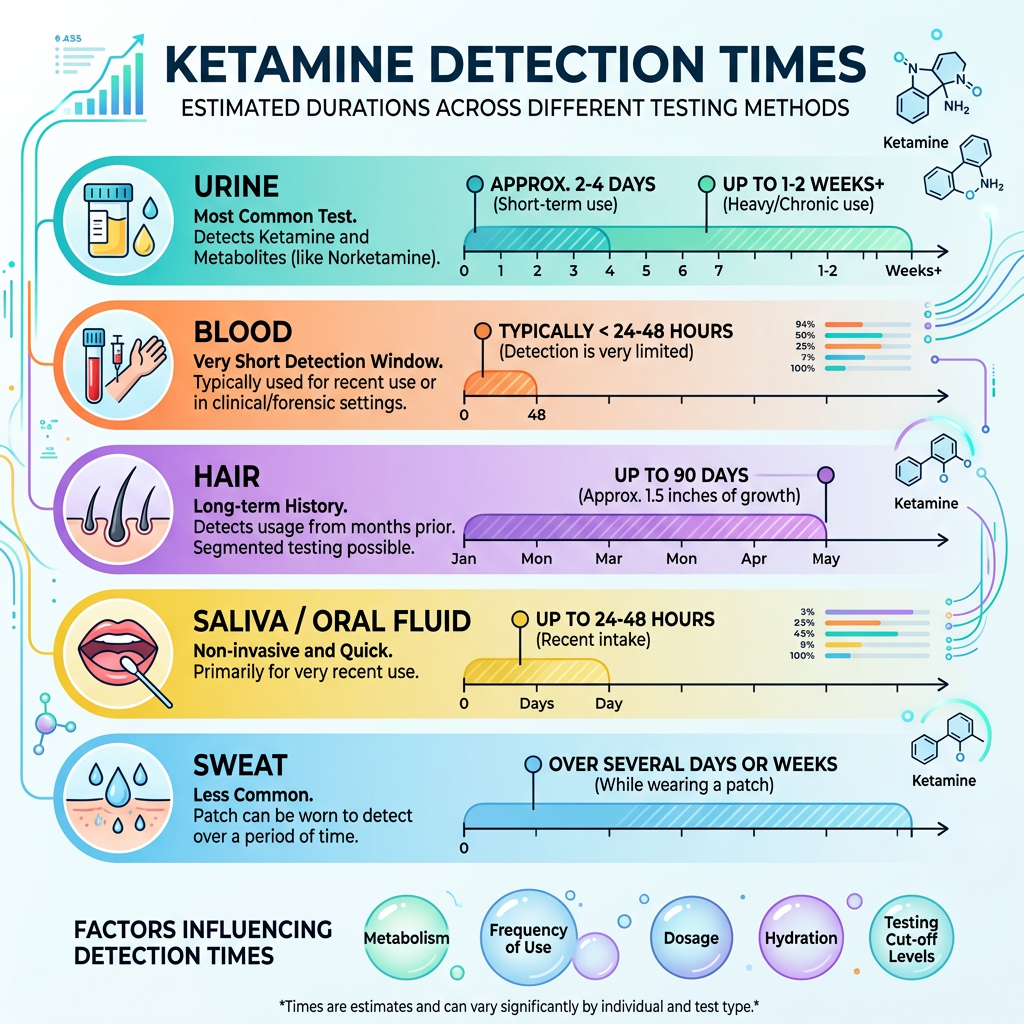
Table of contents
- What is Ketamine and how long does Ketamine stay in your system?
- Is Ketamine addictive?
- What effect does Ketamine have when you take it?
- Dangerous side effects of Ketamine
- Medical emergency from Ketamine use
- What happens if I try and stop taking Ketamine?
- Accidental overdose with Ketamine
- Ketamine withdrawal timeline
- Does Ketamine show up in a drugs test?
- Is there a detox for Ketamine?
- Why can’t I just go cold turkey from Ketamine?
- What about rehab for Ketamine?
- Why is therapy essential when recovering from Ketamine?
- What about individual therapy for Ketamine?
- Relapse prevention for Ketamine and how long does Ketamine stay in your system?
- Aftercare for Ketamine dependency and how long does Ketamine stay in your system?
- What about home treatment for Ketamine addiction?
- How can Find Me a Rehab help with how long does Ketamine stay in your system?
- Get help today for Ketamine addiction and How long does Ketamine stay in your system?
How long does Ketamine stay in your system?
As an experienced addictions clinician with over thirty years experience my question to that is: Why do you need to know?
Is it because you are worried it will show up in a drug screen at work?
Are you worried about being drug tested by the police if you are stopped?
There is certainly a scientific answer to this and we will go through it. However, if you are asking the question you really should be asking why you need to know.
Ketamine, most certainly, has it’s uses: Roadside amputations for severe injury, Bone realignment in A+E and now, in micro dosing, to help people respond to psychotherapy.
We are addictions clinicians.
Each of us have decades of experience in assessing, diagnosing, prescribing for and treating people caught up in addiction.
Our advice is free, impartial and confidential.
How long does Ketamine stay in your system? Read on and find out.
What is Ketamine and how long does Ketamine stay in your system?
Ketamine is an anaesthetic.
It renders you unconscious and also blocks pain signals.
Known as a dissociative anaesthetic, Ketamine will make you feel detached from what is going on around you.
When it is used in hospitals for procedures where you stay awake, you will feel detached from yourself and what is going on around you.
It was first invented in the US in the early 60’s and licenced for use in the early 1970’s.
Vets use Ketamine, especially on larger animals though it still has a valuable part to play in human medicine.
Is Ketamine addictive?
No drug is addictive, it is the effect that it has on the brain that causes the problems. Or, to be more precise, when you stop taking it.
When you take a drug for the first time it will do what it is designed to do. With ketamine it will induce anaesthesia and block pain signals. You may not take enough so you stay awake but you will feel rather detached: This is why you took it.
If you take Ketamine for a period of time, your brain will adjust to it’s continued presence and will make adjustments to the way it work’s. This is both useful for the brain but also problematic.
When your brain makes these adjustments it means that you have reached a state known as physiological tolerance.
The problem then becomes that you will need more and more Ketamine to have the same effect as the amount you took when you first used Ketamine.
If you stop using (or reduce the amount you use took quickly) your brain simply will not be able to cope with the immediate change. It can get back to normal functioning: But this will take time.
Between the time it takes for the brain to adjust and the time you stop incorrect chemical messaging occurs. It is this that causes symptoms known as withdrawal.
What effect does Ketamine have when you take it?
Ketamine was invented to do two things: Put you to sleep and stop pain.
If you inject it, within 30 seconds you will feel high and this can last for up to an hour.
If you smoke or swallow it the effects won’t start for 2 to 5 minutes.
You will feel an overwhelming sense of relaxation. Some people call it a full body buzz, others report that they feel they are floating while some say it is like an out of body experience. Halluncinatons are common.
If you use larger amounts you will experience what is sometimes known as a “K hole”. This can be extremely scary and is often talked about as a near death experience.
How long does Ketamine stay in your system? Don’t worry! We arre getting there.
Dangerous side effects of Ketamine
As with most medication and drugs, Ketamine has side effects.
We have already mentioned severe hallucinations but there are other things to be concerned about:
- High blood pressure
- Disorientation
- Increased heart rate
- Nausea
- Vomiting
- Frequent urine infections
- Permanent bladder damage
- Incontinence
Medical emergency from Ketamine use
If you use a large enough amount of Ketamine it is possible you can experience an acute medical emergency. Namely:
- You stop breathing
- Your heart stops
- Seizures
- Self injury due to being in a K hole
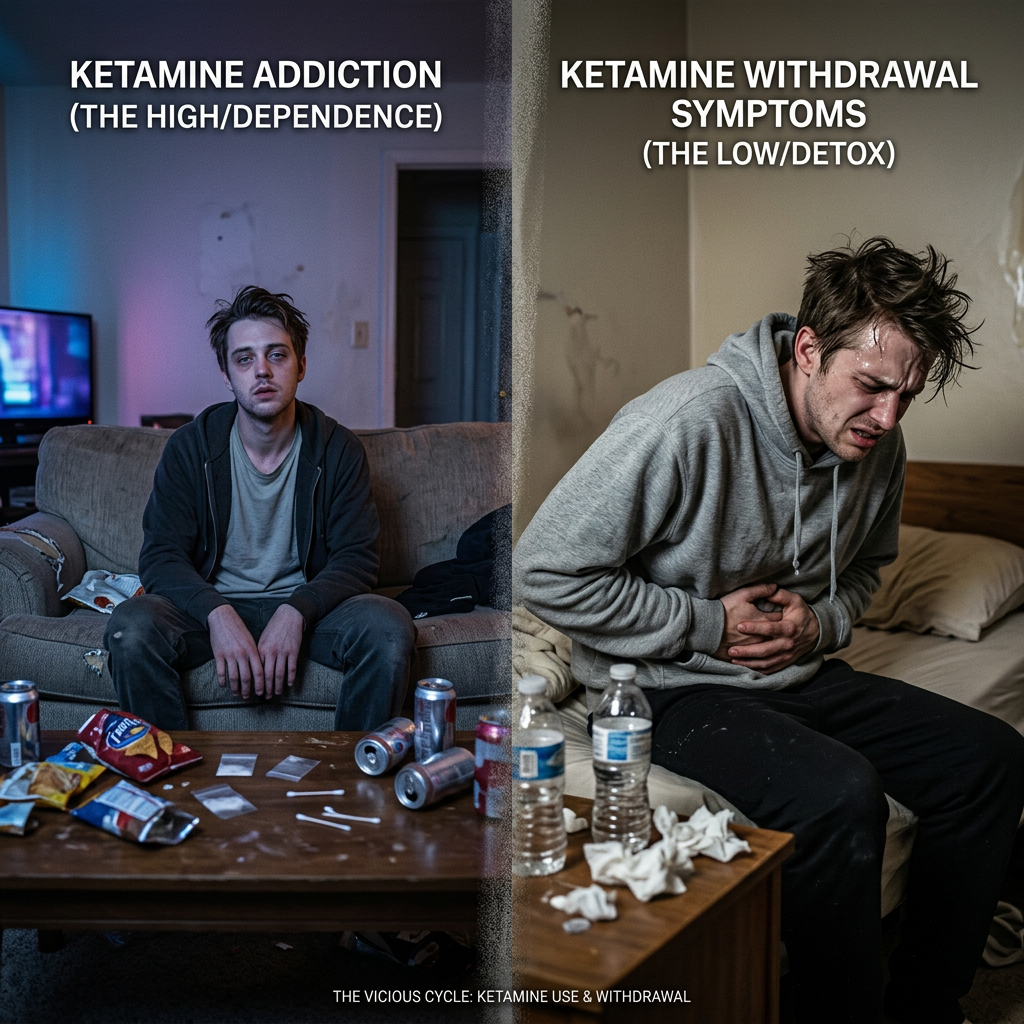
What happens if I try and stop taking Ketamine?
As we explained, earlier, your brain becomes used to Ketamine and adjusts the way it works.
If you stop using it (or reduce too quickly) your brain simply can not cope with this rapid change. It will adjust, in time, but until it does, it will send out incorrect chemical messaging. It is this that causes the symptoms known as withdrawal.
They include:
- Cravings: Your brain knows what will stop the withdrawals which is more Ketamine. Cravings (and giving into them) are nothing to do with willpower or lack of it.
- Rapid low mood: You will very irritable, anxious and feel very empty
- Emotional flatness: Severe feelings of numbness
- Cognitive failures :Memory lapses, poor concentration and brain fog
- Sleep disturbances: Nightmares, poor sleep and severe problems getting to sleep
- Extreme fatigue: Very low energy throughout the day
- Chronic bladder pain: Severe pain, constant urgency, passing blood
- Generalised malaise: Nausea, sweating, tremor, high body temperature
- Suicidal thinking/acting out: Rare but not unknown.
- Dangerously high blood pressure/fast heart rate: This can lead to stroke and fatality
Accidental overdose with Ketamine
If you stop using, or reduce too quickly, your brain will tell you what you don’t want to hear: That only by taking Ketamine will the cravings stop.
When people, out of sheer desperation, take Ketamine when withdrawing they take an amount they think will settle themselves.
The problem is that, when you stop using Ketamine, your brains ability to process it reduces: Fast.
By the time you give in to the cravings (and no one can blame you) your brains tolerance to Ketamine has seriously diminished. Thus you are very likely to overdose.
Very sadly, when people are in this position they die from a Ketamine overdose.
How long does Ketamine stay in your system? Long enough that if you are withdrawing and take Ketamine it can be fatal.
Ketamine withdrawal timeline
There are 4 recognised stages of Ketamine withdrawal:
- Initial stage: Ketamine does not stay in your system for long. Within 2.5 hours over 50% of the Ketamine you have taken will have been rendered inactive. By the end of the first 24 hours you will start to experience withdrawal symptoms
- Peak withdrawal: By day three, the withdrawals will peak.
- Sub acute: Things will start to get better over the next two weeks
- Post Acute Withdrawal: This can take up to one month or even more. Bladder damage can, sadly, be permanent.
Does Ketamine show up in a drugs test?
Usually: No.
Most workplace drug test kits do not screen for Ketamine.
When they do, it will usually show up for 3-5 days, 2-4 days in blood and for up to 3 months in hair follicles.
Of course, there are various factors to consider:
- Sex
- Age
- Physical health
- DNA
- Amount taken
- Quality of the product
- Underlying conditions
Key Takeaways
- Ketamine acts as an anesthetic and produces feelings of detachment, but can lead to harmful side effects and addiction.
- Duration in the system varies, with withdrawal symptoms starting within 24 hours and peaking around day three.
- Medical supervision is crucial during withdrawal to manage risks like high blood pressure and acute emergencies.
- Rehab offers essential support, combining detoxification, therapy, and aftercare for effective recovery.
- It’s vital to address underlying issues through therapy, as addiction stems from unresolved trauma or emotional distress.
Is there a detox for Ketamine?
No.
Well, yes and no.
No, there isn’t a detox for Ketamine as there is for heroin and alcohol where substitute medication is given that mimics the effects of the drug.
With Ketamine adjunctive medication is given that allows a safe progression to abstinence.
When you stop taking Ketamine your blood pressure and pulse can rise to levels that can cause an acute medical emergency and can be fatal. It is essential to control both blood pressure and pulse and this can only be done using prescribed medication under medical supervision.
Medication to assist with anxiety and sleep is also important.
Why can’t I just go cold turkey from Ketamine?
Simple: You run the risk of a stroke , coma and death.
Sorry if that sounds blunt but the risks are extreme.
This is not the type of thing you can treat at home, by yourself and then call an ambulance if something goes wrong.
Ketamine withdrawal is one of the most risky of situations in addiction treatment.
Trying to treat yourself at home is riskier than a game of Russian roulette.
What about rehab for Ketamine?
Rehab offers you the four essential elements for recovery:
- Detox
- Therapy
- Relapse prevention
- Aftercare
Detox, as we have discussed, is essential due to the adverse effects withdrawing from Ketamine can have.
Medication will be prescribed by the in-house clinician, usually on an as and when basis, so that your blood pressure and pulse are stabilised and that you are able to sleep. It will also deal with the extreme anxiety that can occur.
Your brain will really struggle to process therapy while you are still in the early stages of withdrawal. It may be a day or two before you are able to join in with therapy.
How long does Ketamine stay in your system? Long enough that therapy in rehab is only possible once your brain is free of Ketamine.
Why is therapy essential when recovering from Ketamine?
No one chooses to be an addict.
Addiction is a symptom of an underlying issue.
Childhood trauma, relationship breakdown, chronic pain, Whatever the cause the treatment is the same: Group therapy.
If you are thinking that you are the last person who could benefit from a group therapy approach you are precisely the person who will benefit from it.
Group therapy has been the mainstay of addiction treatment for nearly a hundred years. Why? Because it works.
12 STEP, SMART, eclectic: It really doesn’t matter. Time spent worrying about what model is used is time wasted.
You don’t need to follow any religion or believe in a higher power.
Group therapy works: If you work at it!
If you understand why you took Ketamine you can learn strategies to cope without it.
What about individual therapy for Ketamine?
All centres provide a weekly session of individual therapy.
These sessions can be extremely tiring and emotionally draining. Anymore than one session a week can be very counter productive.
Relapse prevention for Ketamine and how long does Ketamine stay in your system?
Knowing how to regulate your emotions and how to deal with stressful situations is key to recovery from Ketamine.
Rehab is a fully staffed 24/7 environment where there is always someone on hand if you are struggling.
When you are back at home, support is available, but you are now equipped to deal with situations yourself.
Relapse prevention is about giving you the psychological skills to cope.
Relapse happens: Fact.
It is not failure but part of the cycle of a chronic illness just as much as when someone with diabetes or asthma has a crisis.
As Winston Churchill said: Never miss the opportunity of a crisis.
A relapse is a test of your skills.
Aftercare for Ketamine dependency and how long does Ketamine stay in your system?
Aftercare is essential.
Addiction is a lifelong condition. With the right support, information and personal commitment to abstinence it can be done!
Aftercare usually means regular telephone check in from your rehab centre for the first year following treatment.
There will also be a weekly support group (either in person or remotely) as well as a number to call if you are struggling.
What about home treatment for Ketamine addiction?
We would strongly advise against this.
You would need 24/7 specialist nursing support and close monitoring by a clinician.
The cost of treatment at home would be far in excess of residential treatment.
In any event, treatment without therapy, relapse prevention and aftercare is a recipe for one thing: Relapse.
Addiction masks difficult thoughts and emotions. If you detox without dealing with these, you will go back to what you know can provide that mask: Ketamine.
How can Find Me a Rehab help with how long does Ketamine stay in your system?
We are addictions clinicians.
Each of us has over thirty years experience in assessing, diagnosing, prescribing for and treating people caught up in addiction.
Between us, we have worked in most of the rehab centres in the UK.
Our advice is free and confidential.
We only signpost to legally registered services.
If you want to know How long does Ketamine stay in your system we can answer your questions: For free and in total confidence.
How long does Ketamine stay in your system? Call and speak with an experienced addictions clinician.
We never charge for advice or referrals.
Get help today for Ketamine addiction and How long does Ketamine stay in your system?
Call, email, Whattsap or live chat to speak with an experienced addictions clinician on any aspect of addiction including detox, rehab, home detox, therapy, relapse prevention and aftercare.
We can advise you on treatment options, treatment plans, locations, costings and logistics.
How long does Ketamine stay in your system? Wrong question. The question should be: How can I get free of Ketamine?
Need help finding the right rehab for you or a loved one? Get in touch today and take the first step toward recovery.
Speak to usRecent Posts
How long does Ketamine stay in your system?
How long does Ketamine stay in your system? As an experienced addictions clinician with over thirty years experience my question to that is: Why do you need to know? Is it because you are worried it will show up in a drug screen at work? Are you worried about being drug tested by the police…
Grace Kennedy
12:23 pm, July 2, 2026
Can you become addicted to Paracetamol?
Can you become addicted to Paracetamol? No. Well not it in the same way you become addicted to heroin or alcohol as the way it affects the brain is different. That doesn't mean that some people are not addicted to taking it in the way that they take it, repeatedly. How does Paracetamol work? The…
Grace Kennedy
6:08 pm, June 26, 2026
Can you do a Methadone detox at home?
Can you do a Methadone detox at home? In theory: Yes. In practice: No. It is a nice idea that you can stay at home, take some methadone and your opioid use disorder is cured. Sadly it just doesn't work like that. In order to understand why this won't work you need to know what…
Grace Kennedy
6:49 pm, June 25, 2026